Showing posts with label Notebook. Show all posts

Friday, January 28, 2011

Apple MacBook Pro 17-inch Notebook Review

Apple Mac Pro Review are happy to stock the fantastic Apple MacBook Pro 17-inch Notebook.
With so many available today, it is good to have a brand you can recognise. The Apple MacBook Pro 17-inch Notebook is certainly that and will be a great purchase.
For this reduced price, the Apple MacBook Pro 17-inch Notebook is widely recommended and is a regular choice with lots of people. Apple Computer have included some great touches and this equals great value for money.
Features:
  • 2.8GHz Intel Core 2 Duo , 8GB DDR3 SDRAM, 500 GB SATA HD, 8x SuperDrive (DVD±R DL/DVD±RW/CD-RW),
  • NVIDIA GeForce 9600M GT, iSight camera; Mini DisplayPort output port with support for DVI, VGA, and dual-link DVI , omnidirectional microphone
  • 10/100/1000BASE-T (Gigabit) Ethernet, AirPort Extreme Wi-Fi , Bluetooth 2.1 + EDR
  • 17-inch (diagonal) high-resolution LED-backlit glossy widescreen display, 1920-by-1200 resolution, Mac OS X v10.6 Snow Leopard
Following on the heels of the 15.4-inch MacBook Pro and replacing the 17-inch PowerBook G4, the 17-inch MacBook Pro delivers many of the same beloved features as its little sibling, such as a scrolling track pad, the Sudden Motion Sensor, and an excellent software package, and adds a huge, bright 17-inch display that's great for graphics work. Better yet, our fully loaded test configuration powered through most of CNET Labs' performance tests, exhibiting only a few of the growing pains encountered by other Intel-based Apple laptops and desktops, such as the iMac Core Duo. Of course, such performance doesn't come cheap: the 17-inch MacBook Pro's default configuration costs $2,799 (upgrades on our review unit brought the price up to $3,099). But for graphics professionals and other Mac users who have money to spare, the 17-inch MacBook Pro is a dream.
With the MacBook Pro, Apple hasn't radically redesigned the PowerBook form factor, it has just made a few refinements to it. Measuring 15.4 inches wide, 10.4 inches deep, and 1 inch thick, the sleek, aluminum MacBook Pro looks very similar to the 17-inch PowerBook G4 it replaces. At 6.8 pounds, the 17-inch MacBook Pro is a hair lighter than its predecessor and the lightest laptop of its size on the market. With its AC adapter, which like other Apple laptops connects magnetically to the case, the MacBook Pro weighs 7.9 pounds. For the sake of comparison, the Dell Inspiron E1705 weighs 8.2 pounds, while the Toshiba Qosmio G35 weighs 10.2 pounds.
Underneath the lid, the MacBook Pro extends the tradition of the PowerBook's minimalist design. The MacBook Pro has just a power button, a big keyboard framed by stereo speakers, a very large touch pad with a single mouse button, and a handy built-in iSight camera that sits above the display. Though the keys are a bit shallow, they're comfortable to type on, and we love the keyboard's backlighting feature, which adjusts to changes in ambient light levels. We don't like that the keyboard is located 5.4 inches back from the laptop's front edge; we wish it were centered to encourage a more ergonomic typing position. The touch pad lets you scroll through long documents, Web pages, and spreadsheets by dragging two fingers down or across the pad, a terrific feature that's unique to Apple laptops. Arguably the 17-inch MacBook Pro's most stunning feature is its display: the large wide-screen display features a fine 1,680x1,050 native resolution.
The 17-inch MacBook Pro offers a decent selection of ports and connections, though it comes up a bit short of what you'll find on a similarly sized PC laptop, including the Inspiron E1705. That said, the MacBook Pro features three USB 2.0 ports; FireWire 400 and FireWire 800 ports; an ExpressCard slot; and a DVI port (VGA with included adapter) for connecting to an external monitor. It's also equipped with Bluetooth 2.0+EDR (enhanced data rate), and you can access the Internet via 802.11g Wi-Fi radio, and Gigabit Ethernet. As with the PowerBook, the MacBook Pro features a slot-loading SuperDrive that plays and burns DVDs and CDs. One new extra is the Apple remote that controls the included Front Row multimedia player; we wish, though, that the MacBook had a storage slot for it. Unlike most PC laptops, the MacBook Pro lacks a built-in media reader for flash memory cards, and there's no S-Video output or built-in modem--both of which the PowerBook had.
The MacBook Pro ships with Mac OS X Tiger, highlights of which include the incredibly cool Spotlight search utility and the customizable Dashboard, a collection of handy desktop tools. Also included is the robust iLife '06 software suite, Front Row media center software, and a handful of other apps. In addition, the beta of Boot Camp lets you turn the MacBook into a dual-boot machine that runs full versions of Mac OS X and Windows XP (though you need to purchase a full version of Windows separately).
The 17-inch MacBook Pro comes in one default configuration that costs $2,799. Though there aren't a lot of upgrade options, our review unit included RAM and hard drive enhancements that brought the price up to $3,099. For that much money, you'd expect some pretty high-end specs, and the MacBook delivers; it has a fast, 2.16GHz Intel Core Duo processor; 2GB of speedy 667MHz DDR2 RAM; an ATI Mobility Radeon X1600 graphics card with 256MB of VRAM; and a blazing 7,200rpm, 100GB hard drive. Still, the MacBook Pro is a bit more expensive than similarly configured Windows laptops; for example, an Inspiron E1705 with comparable specs costs $2,889.

Read rest of entry

Apple MacBook Pro MC374LL/A 13.3-Inch

Apple Mac Pro Review are delighted to stock the excellent Apple MacBook Pro MC374LL/A 13.3-Inch Laptop.
With so many on offer today, it is good to have a brand you can trust. The Apple MacBook Pro MC374LL/A 13.3-Inch Laptop is certainly that and will be a superb buy.
For this price, the Apple MacBook Pro MC374LL/A 13.3-Inch Laptop is highly respected and is a popular choice for most people. Apple Computer have included some nice touches and this means great value for money.
Features:
  • 2.4GHz Intel Core 2 Duo
  • 250 GB Hard Drive, 8x DVD/CD SuperDrive, 4GB DDR3 RAM
  • 13.3 inch LED-backlit display, 1280-by-800 resolution
  • NVIDIA GeForce 320M graphics processor with 256 MB of shared memory
  • Mac OS X v10.6 Snow Leopard Operating System
1) The MBP 13 now has 4 gb of ram standard (2 x 2 gb sticks). This allows you to multi-task easily without any issues ( last years model had only 2gb of ram which was inadequate) Now there's no need to spend more money upgrading your ram UNLESS you're really into heavy duty multimedia work

2) It also features the Nvidia GeForce 320M integrated graphics processor with 48 processing cores. This is an improvement compared to the Geforce 9400M graphics chip in last years model and will help in graphics and content creation.

3) The included hard drive is 250 gb (160gb in last years model).

4) Mini display port now supports video AND sound with a compatible Mini-DP to HDMI adapter (last years model only supported video) 
Read rest of entry

Thursday, January 27, 2011

Alienware M17x R.3 17.3-inch 3D Gaming Laptop Review

In an earlier review, the base configuration of the Alienware M17x R.3 (R.3 stands for Revision 3) was rated. Today, the 3D version of the M17x R.3 is up for review. The price point on this model is substantially higher starting at $1,924 with the upgraded screen and 3D Vision bundle, along with a required video card upgrade.

For starters, since the 3D version of the Alienware M17x R.3 is just an upgraded base M17x R.3, the design is the same. The refreshed M17x features a soft touch finish that was originally in the M11x. Two color schemes are available: stealth black and nebula red. Overall, the M17x R.3 is a nicely designed machine with a great feel.

Considering this review is dedicated to the 3D M17x R3 configuration, it's imperative to discuss the display. The bulk of what drives the price from $1,499 for the base model to $1,924 for the 3D version is the upgraded screen. For $350, you get the NVIDIA 3D Vision Bundle and a full 1080p 120Hz WLED screen with a max resolution of 1920x1080. It's a very nice display that offers gorgeous HD resolution for gaming and enjoying movies.

In order to configure the Alienware M17x R.3 into a 3D model, you'll need to also upgrade the graphics card from the AMD Radeon 6870M to the NVIDIA GTX 460M with 1.5GB of GDDR5. This is in order to take advantage of NVIDIA 3D Vision. Normally for around $2,000, I'd hope for a higher-end card (such as the NVIDIA GTX 480M), but since this system is a 3D model, you're paying for that feature.


Processing power is solid with an Intel Core i7-2630QM that runs at 2.0GHz and can Turbo up to 2.8GHz. This 2nd Generation Sandy Bridge CPU features 6MB of cache. Of course, if you want only the fastest speeds, an upgrade to the Intel Core i7-2820QM with 8MB of cache is available.

Unfortunately, the saying "all good things must come to an end" rings true. While the display and processor offer excellent qualities, the amount of memory does not. For over $1,924, only 4GB of memory is standard. To upgrade to 8GB is another $250. That is absurdly expensive. If you're into gaming and spending this much for a laptop, having only 4GB of memory at your disposal is a definite drawback.

Hard drive space is also a bit scarce at 320GB, although it is a fast 7200RPM model. However, you can purchase two 320GB drives in RAID 0 configuration for $150 more. Another option you may want to consider is upgrading to a Blu-ray drive, since the display features HD resolution.


To sum up the Alienware M17x R.3 (3D model), it's a slick gaming notebook that offers enhanced 3D gameplay. The large 17.3-inch display and high definition screen make it a great desktop replacement. But the lack of memory is a definite bummer. It'd also be nice if a higher performance video card was available as an option, but it is understandable why it isn't. A higher end card draws more power, and more power equals added weight and heat. This brings us to the Alienware M17x R3's dimensions. The weight of the M17x with a 9-cell battery starts at 9.4 pounds, but of course weight is based on how the system is configured. The R.3 is slightly thinner at 1.77 inches compared to the past, which measured in at over 2 inches. While you won't want to lug around the M17x everywhere you go, this desktop replacement can travel with you on occasional trips.

Overall, the Alienware M17x R.3 (3D model) is best suited for moderate gamers looking to play in 3D. It's easy to enjoy HD multimedia, especially when combined with the upgraded Blu-ray drive. The design and soft touch finish add a nice feel to a notebook that is built for gaming.
VNH2BCAZKCPF
Read rest of entry

Monday, January 24, 2011

HP Pavilion Dv5t

You might call it a notebook that walks the line—several of them at once, in fact. Equipped with a Core i5 CPU, a Blu-ray drive, and copious amounts of storage, the HP Pavilion dv5t is a well-appointed notebook designed for frequent travel, yet powerful enough to handle most of your multimedia-playback needs, as well as crunch through home-productivity tasks. (It's a configurable machine, and prices start at $599.99; our tricked-out review model, as configured, will set you back a cool $948.99.) It walks the line in the sense that while it is capable of satisfying many uses, it doesn't fully excel at any one. As a result, it left us a little hazy about exactly who this notebook is best for. It manages the portability side with its reasonable size/weight and better-than-average battery life, and it can satisfy a high-definition craving with its Blu-ray drive and integrated HD graphics. But it's not quite light enough to go everywhere with you; the integrated graphics are good enough for playing video but not high-end 3D games; and without dedicated media controls, that Blu-ray drive might get less use than it would otherwise. That said, this is still a powerful laptop and a strong choice for those who value speed and versatility.
 
HP Pavilion DV5T
Smooth lines and a Champagne finish give the dv5t a touch of style.
  
HP has introduced three new color options for the Pavilion line with this model: Black Cherry, Sonoma Red, and Champagne. Our test model featured the last of the three, with a silvery lid in a subtle kaleidoscope-like pattern. A big plus for the finish on the chassis: It's impervious to fingerprint smudges. The chassis also has a bit of heft; weighing 5.2 pounds and measuring 1.4 inches thick, this notebook is heavier than Lenovo’s IdeaPad Y460, which is priced similarly and roughly the same size. It's also a bit bulkier, but it's still manageable for travel.
One reason for the extra bulk has to do with the display. The LCD panel measures 14.5 inches (diagonally), an odd size that's exclusive to HP. The screen has a maximum resolution of 1,366x768 with a 16-to-9 aspect ratio, and it's able to display high-definition video in 720p. It uses LED backlighting to produce a bright, crisp picture with very high detail. If you're likely to watch high-definition content on your laptop, you will appreciate the inclusion of a Blu-ray-reader/DVD-burner combo drive on this model. In our tests, the movie Repo Men on Blu-ray disc looked sharp, and the screen delivered vivid colors and good viewing angles. Not so spectacular, though, is the speaker system; the two speakers embedded in the lower chassis aren’t very loud and sound way too tinny when the volume is cranked up.
 
HP Pavilion DV5T
On the right is the Blu-ray/DVD±RW combo drive, two USB ports, and the power jack.
As for the keyboard, the design comprises black isolated keys (a Chiclet-style keyboard). On our test unit, it was surrounded by a roomy deck treated with the same Champagne finish found on the lid. The keyboard is firm and comfortable, and the touch pad is responsive. One big omission, though, is a set of dedicated media-playback buttons, which is surprising considering that HP claims this model is geared for entertainment and productivity use. (Heck, we’d even settle for a volume slider.) Instead, all player and volume controls are relegated to key combinations within the function-key group. Backlighting for the keyboard is a $25 option; we couldn't evaluate how it looked, though, as it was not included on our review machine.
 
hp pavilion dv5t
The Chiclet keyboard is comfortable and easy to type on.

 
You'll find only three USB ports on the dv5t, and one of them is an eSATA/USB combo port, which allows for faster data transfers with eSATA-compliant external storage devices. The combo port is mounted on the left side of the notebook alongside HDMI and VGA video outputs, an Ethernet port, and a pair of audio jacks. On the right side is a pair of ordinary USB ports and the optical drive. Wireless connectivity comprises built-in Bluetooth and Wi-Fi (802.11b/g/n) radios. Rounding out the feature set is a Webcam built into the screen bezel, and, inside the chassis on the model we looked at, a fast (7,200rpm) hard drive with 500GB of capacity.
 
HP Pavilion DV5T
Here we have VGA, Ethernet, HDMI, eSATA/USB, and headphone/microphone ports, all situated on the left side.
When it comes to handling multimedia and productivity tasks, the Pavilion dv5t is a solid performer. Our test model was fueled by Intel’s Core i5-430M processor and 4GB of memory. Its score of 5,758 on our 64-bit PCMark Vantage test, which measures overall system performance, was almost 500 points above the average score for thin-and-lights and was right behind its 14-inch sister system, the Pavilion dm4t (5,933). It couldn’t keep pace with the previously mentioned Lenovo IdeaPad Y460 (6,618), however, which, despite being roughly the same price and size, uses a more powerful processor and has a discrete GPU. (It also happens to be an Editors’ Choice winner.) The dv5t turned in a score of 5,400 on the 32-bit version of the same test, which was more than 1,700 points above average but still a bit shy of the dm4t’s score of 5,516. Overall, these scores indicate that when you're processing Microsoft Office files, removing red-eye from photos, or surfing the Web, the dv5t will not keep you waiting.
The dv5t made fast work of our iTunes encoding test, in which the tested computer converts 11 MP3 files to AAC format. (It took 3 minutes and 21 seconds to complete this task.) Performance on our Windows Media Encoder (WME) video-encoding test was similarly speedy; it took the dv5t 4 minutes and 25 seconds to finish rendering our test video, although, as with PCMark Vantage, the IdeaPad Y460 was significantly faster. On our processor-intensive 64-bit Cinebench 10 test, the dv5t’s score of 7,685 was more than 1,200 points above average but lagged behind the dm4t by 505 points and the IdeaPad Y460 by 581 points.
Results from the 32-bit version of Cinebench 10 were similar; the dv5t’s score of 6,365 was above average but trailed the Pavilion dm4t and IdeaPad Y460. (We run both 32-bit and 64-bit tests for comparison, since not all laptops come with 64-bit operating systems.) These scores indicate that processor-intensive tasks, such as converting music or video files, will be fast enough to do on a regular basis. If truly demanding tasks like video editing are the core of your profession, you'll want something more powerful, but for the average home user, this is generally impressive performance. The other two systems referenced here perform a bit faster, so if every second counts, you'll want to give them a close look.
Graphics performance was what you'd expect from a laptop with an integrated graphics accelerator. On our 3DMark06 test, which measures DirectX 9 gaming performance, we saw a score of 2,084 at 1,024x768 resolution, slightly lower than average for a thin-and-light laptop. The IdeaPad Y460 and its ATI Radeon HD 5650 graphics card, on the other hand, scored an impressive 8,004 on this test. Gaming performance was no bright spot, either. The dv5t managed just 17.5 frames per second (fps) on our real-world Company of Heroes gaming test, and that was at a low resolution (1,024x768). At its native resolution (1,366x768), it limped along at an unplayable 13.4fps. By way of contrast, the IdeaPad Y460 gave us 74.8fps. What's clear: If you’re looking for a laptop that’ll excel at 3D gaming, the dv5t is not it.
   
HP Pavilion dv5t
The smudge-free keyboard deck shares the same finish as the lid but lacks media player controls.
On the flip side, we were pleased with the dv5t’s battery endurance. On our DVD rundown test, we loop playback of a DVD movie from the laptop's optical drive until the battery dies. The dv5t endured for 3 hours and 28 minutes, more than half an hour longer than what we got from the IdeaPad Y460 and nearly 20 minutes longer than the average time for a thin-and-light notebook. The Pavilion dm4t we tested lasted almost a full hour longer, however.
The hard drive comes with Windows 7 Home Premium (64-bit) as well as Microsoft Works and CyberLink DVD suite. Trial versions of Office 2007, Norton Internet Security, a boatload of games, and eBay adware are, regrettably, also part of the deal. On the plus side, you get HP’s Recovery Manager utility, which makes performing a system recovery and reinstalling drivers and other software easy. HP’s QuickWeb program, which gets you onto the Internet without having to boot into Windows, is also onboard. HP covers the dv5t with an industry-standard one-year parts-and-labor warranty, which comprises round-the-clock toll-free tech support, as well as one hour of e-mail or real-time chat assistance. This last part is a nice touch, but one hour seems a little skimpy if you've got a real problem to solve.
All in all, the HP Pavilion dv5t is a capable multimedia notebook that delivers good performance in a moderately thin-and-light frame. We wish it had better 3D chops, less bloatware, and some entertainment-centric controls to go with the Blu-ray drive. If you require more graphics muscle, consider spending an extra $100 for the Lenovo IdeaPad Y460, which has a switchable GPU (so you can choose between battery life and graphics performance with the press of a button) and delivers gaming-class 3D power on demand. But if you're looking for a stylish, portable notebook that can scratch your Blu-ray itch, this is it.

John R. Delaney 
Read rest of entry

Toshiba Qosmio X500 Gaming Notebook

Toshiba Qosmio X500
Gaming laptops are generally big and heavy and don’t offer much in terms of battery life. Where they do shine is allowing you to carry your gaming rig with you. Now when we are expecting a gaming laptop to drop in, we usually think it would be an Alienware or an ASUS, so we were a bit intrigued when Toshiba called us asking if they can send their Qosmio for review. Our response was- hell yeah!.
Looking at the specifications, the Qosmio fits right at home with the bad boys of mobile gaming. Its based on the quad core Intel Core i7 CPU running eight threads at 1.60GHz along with 8GB RAM and a GeForce GTS 360M with 1GB dedicated frame buffer. That is enough to put most desktops to shame. However, Toshiba doesn’t stop there. The Qosmio is equipped with a beautiful 18.4” screen with full HD 1920×1080 resolution and a Bluray drive and quality harmon/kardon speakers to enjoy movies in full glory.
Storage is the only area where I think Toshiba could have improved upon. Even though the unit features two 500GB drives, they run at 5400RPM. Ideally, Toshiba should have replaced one of these drives with a 128GB SSD. For communications, you have the built-in wired Gigabit Ethernet along with the older 802.11b/g Wi-Fi standard. I wont be surprised if this gets bumped up to 802.11n specs though the lack of Bluetooth is a bit of a mystery.
The Toshiba Qosmio is certainly big and heavy but with its black body and red outlines, it looks pretty good. The left side of the keyboard has touch buttons to navigate your media as well as volume controls and a nice big power button. On the left side, you have a Gigabit network adapter, an eSATA and a USB port, a four pin Firewire port as well as the optical drive and a PC Express slot.
The front is mainly clean with the exception of a memory card reader and a wireless switch. Some LEDs also reside on the front for charging, disk activity etc. The right side has the power connector, VGA output, two more USB ports and audio input and output.
The huge size of the Qosmio allows for a full sized keyboard along with a nicely sized keypad below which sits the trackpad. The keys are a bit too glossy and slippery for my liking but then, so are the ones in many gaming keyboards such as the Razer Lycosa. Also, the multi-touch and gesture enabled trackpad is a bit small in size but considering that this laptop is mainly for gaming, you will connect an external mouse to it. Thankfully, Toshiba adds a button that quickly enables/disabled the trackpad.
The 18.4” Full HD TruBrite screen with an 8m response time is pretty impressive to say the least. While it has a bit of gloss factor, thankfully its nowhere close to what you see on an Apple MacBook Pro. The viewing angles are also better than most laptops we’ve tested of late and the slight glossiness certainly causes the colors to look pretty sharp. Playing games on the screen of this Qosmio is as equally impressive as watching Blu-ray movies using the Blu-ray drive.
As expected, battery life on the Qosmio isn’t the greatest- it never is on gaming laptops. We managed to get about 90 minutes on it. Interestingly, the laptop never really got too noisy- something most gaming laptops are dreaded with. Running intensive benchmarks did make the fan come on but again, it wasn’t too noisy. Also, the only area that gets pretty warm is right on top between the speakers- an area you wont be accessing frequently. Toshiba has done a good job designing the cooling of the Qosmio X500
In summary, the Toshiba Qosmio X500 is an incredibly powerful laptop with a gorgeous screen which could’ve been a lot better had Toshiba equipped it with an SSD. At AED 9,099, the (US$2500), the Qomsio X500 is decently priced for a gaming laptop with such specifications.

Read rest of entry

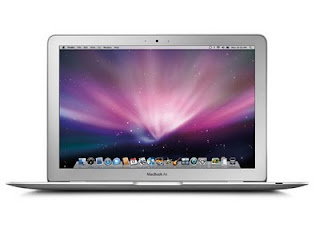
Macbook Air 11.6inch

The 11.6inch Macbook Air is a beautiful, solid and eye-catching laptop which feels premium all over. These review will be more useful for customers which are going to buy MacBook Air 11.6inch in apple store.It delivers much higher performance than the typical netbooks, and thanks to its SSD storage this mini laptop never keeps you waiting. Keyboard and touchpad are extremely well-designed, just like every other Apple laptops out there. The only thing that will hold most people back is the high price of this mini laptop ($999 for 64GB version and $1199 for the 128GB version ).
Design:

The 11.6-inch Macbook Air is incredibly thin and light. It measures 11.8 x 7.56 x 0.68 inches at its thickest point, and weight just 2.3 pounds. The full unibody aluminum chassis is solid, beautifully designed, and feels premium all over. Despite the super slim design, the manufacturer still manages to include two USB ports (one on each side), a headphone jack on the left, and a mini DisplayPort on the right. The only thing missing is the SD Card slot, which can be found on most 10-inch netbooks.

Keyboard and Touchpad:

Both the full-size keyboard and extra-large glass touchpad on the Macbook Air 11 are excellent. The chiclet-style keyboard provides crisp feedback, and multitouch gestures perform extremely well on the touchpad. If we were to find something to complain about them, it will be the lack of backlit for the keyboard, which is available on the Macbook Pro.

Performance:

The 11-inch Macbook Air runs on the 1.4GHz Intel Core 2 Duo SU9400 processor, which is a previous-generation Intel technology. In the GeekBench test, the Air scored 2,159, which is lower than some cheaper ultraportable laptops that run on Intel’s latest Core processors. For example, the $899 version of the Acer Aspire Timeline 1830T that runs on Intel Core i7 CPU scores a whopping 3,742 in GeekBench. Having said that, the 11-inch MacBook Air still feels very fast, especially when it comes to booting up (15 seconds) and waking up from sleep mode (instantaneous), thanks to the SSD storage which is significantly faster than the hard-disk.

Battery Life

Laptop Magazine gets 5 hours and 18 minutes of battery life in their battery test which involve continuous web surfing over Wi-Fi at 40 percent screen brightness; PC Mag gets 3 hours 44 minutes from their continuous MP4 video playback test; and CNet Australia gets 4 hours 23 minutes from their video playback battery drain test. Based on the test results above, it’s save to say that you will get at least 4.5 hours of battery life under normal usage.
Read rest of entry

Lenovo Z560 review

Lenovo has a long-standing pedigree with its ThinkPad range of business laptops, but the more consumer-focused Ideapad range is often overlooked. The Z560 is one of the newest models in the series and features the same solid build quality in a well-designed body.
The 15in Z560 has an Intel Core i5-450M processor that runs at 2.4GHz, and supports Turbo Boost for increased performance in single-threaded programs. While there are faster mobile Core i5 chips, this should still be enough power for almost any application. There’s also a mammoth 6GB of RAM, so only the most extreme amounts of multi-tasking should slow it down. Lenovo has sensibly used the 64-bit version of Windows 7 Home Premium to make the most of the extra memory, which was reflected in our benchmarks. A score of 112 in the image-editing test is great and an overall score of 93 is also impressive.
There’s a dedicated graphics card in the shape of an Nvidia GeForce 310M. It’s a strange choice, as it's not really much faster than the processor’s integrated graphics chip. Both chips can play 720p video smoothly on the laptop's screen, or Full HD content on an external display via HDMI. The GeForce chip has 512MB of dedicated memory, but with 6GB on-board, you'd hardly notice if the integrated chip borrowed this amount of RAM from main memory.
The dedicated chip managed a score of 17fps in our Call of Duty 4 test, which is a few frames per second quicker than the on-board graphics, but still not fast enough to be playable. Older games should run reasonably well, but there are far better choices at this price if gaming is a priority.

A stainless steel wrist rest gives the Z560 a premium look, with all the fittings and hinges feeling sturdy. The keyboard has odd keys that are best described as shield-shaped; they curve slightly at the top and bottom which reduces the overall size, making it occasionally difficult to type on. The keys are all very close together in order to squeeze in a number pad, which is less than full size. While it’s a useful inclusion, we would have preferred a larger alphabetical keyboard. There’s hardly any flex in the keyboard tray and there was good tactile feedback, so given a few hours to adapt it’s actually a very good keyboard.
The ridged touchpad is fairly responsive, but there are no multi-touch gestures and it’s slightly too small to span the screen in one movement. The touchpad buttons have very long travel times and felt slightly loose, which is the only part of the laptop with questionable build quality.

The 15in screen has a 1,366x768 resolution that’s large enough to have two documents side-by-side, but not enough for 1080p video. Unusually, a hot-key changes between three preset colour modes, but the differences between them were minimal. Colours were accurate and contrast was high, even at low brightness levels. The pair of speakers above the keyboard produced average quality audio, but they were far from the worst we’ve heard from a laptop.
Almost five hours of battery life is very reasonable given the powerful components, and the 640GB hard disk is generous. As with most laptops, though, the Z560 comes in a range of different configurations, and this is one of the more expensive versions. Given that you can buy a Core i3-equipped version with 2GB of RAM and a 320GB disk for under £500, this particular model looks over-priced. Unless you plan on using programs that need the extra memory, there's little reason to buy this particular incarnation of the Z560.
Author: Tom Morgan
Read rest of entry

Sony Vaio NW20

The newest model in Sony's budget NW20 range is similar in design to the NW11S/S model we reviewed four month ago. However, beneath the funky silver wood-grain effect is a much more modest specification. You still get Sony's attention to detail and exemplary build quality, but there are a number of compromises at this price.
First of all, the Pentium T4300 processor at the heart of the NW20 is fundamentally the same as the Core 2 Duo chips that we've seen in other laptops, but with only 1MB of cache. This was evident in our benchmarks, where the NW20 scored 56 overall. This level of performance is more than adequate for office and internet applications, and with two cores the T4300 can handle multiple applications open at one time.
Intel's GMA 4500M is about the lowest level of graphics performance you can get in a laptop these days. The HD version of this chipset can decode 1080p Blu-ray video, but the Vaio streamed YouTube's new 1080p content with no problems.
In our Call of Duty 4 benchmark, the NW20 scored a measly 4.5fps, which means it's limited to playing much older games or those with 2D graphics. Neither games nor movies will be flattered by the NW20's dull screen; despite a glossy finish, colours were muted and contrast was poor. The problem is partly the fault of the backlight, which is dim around the edges of the screen.
As ever, Sony's keyboard is well designed. It has separated keys that have a light action with a definite feedback. Sony has also shoe-horned a numeric keypad into the case, and there's plenty of room for all the keys in their standard positions. The translucent touchpad is large and responsive, with large, separate buttons that have a light action.
Although it has both Gigabit Ethernet and 80211.n WiFi, for the fastest of both networking worlds, the NW20 lacks Bluetooth and has only a half-sized ExpressCard slot. It managed to last an impressive four hours between charges, though. Its smart design and build quality can't quite make up for the lack of performance and the dull display, but it's still a decent laptop.

Specifications:
Part Code VGNNW20EF/S.CEK
Review Date 13 Jan 2010
Processor Intel Pentium T4300
Processor clock speed 2.1GHz
Memory 3.00GB
Memory slots 2
Memory slots free 0
Maximum memory 8GB
Size 29x370x249mm
Weight 2.7kg
Sound Realtek High Definition Audio
Pointing device touchpad
Power consumption standby 1W
Power consumption idle 24W
Power consumption active 41W
Viewable size 15.6 in
Native resolution 1,366x768
Graphics Processor Intel GMA 4500M
Graphics/video ports VGA
Graphics Memory 128MB
Total storage capacity 320GB
Optical drive model Matshita UJ880AS
Optical drive type DVD+/-RW +/-DL DVD-RAM
Read rest of entry
 

Gadget and Information Technology Reviews Copyright © 2011 Gadget Blog is Designed by examworld Sponsored by Blog Tutorial